
Aon Runs Stablecoin Payment Test With Coinbase and Paxos
Aon tests stablecoin insurance premium payments in a proof-of-concept with Coinbase and Paxos, using Circle's USDC on Ethereum and Solana, March 2026.
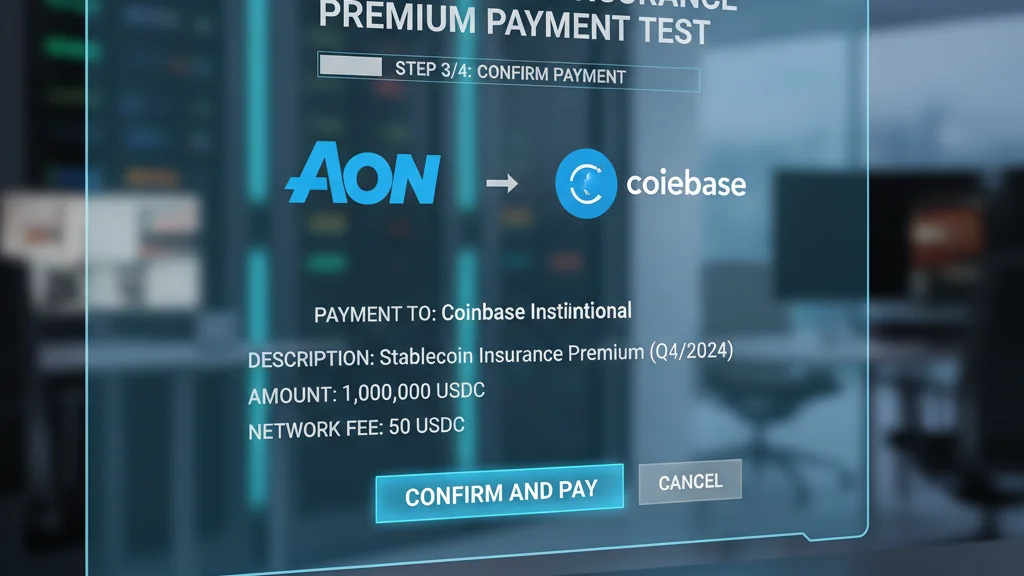
What to Know
- Aon, one of the world's largest insurance brokers advising on $5 trillion in assets, completed a stablecoin premium settlement proof-of-concept
- Transactions used Circle's USDC token across both Ethereum and Solana networks, in partnership with Coinbase and Paxos
- Aon says this is the first known instance of a major global insurance broker accepting stablecoins for premium settlement, even in a controlled test
- The move comes as the $300 billion stablecoin sector pushes deeper into traditional corporate finance following the U.S. GENIUS Act passed in 2025
Aon stablecoin insurance premium payment — that phrase just became real. The London-based insurance brokerage, which oversees advice on $5 trillion in client assets, completed a proof-of-concept on Monday that settled insurance premiums using dollar-pegged tokens, marking what the company calls the first known example of a major global insurer accepting stablecoins for this purpose.
How Aon's Stablecoin Settlement Test Worked
Aon worked with Coinbase and blockchain infrastructure company Paxos to run the transactions. The settlement used USDC — Circle Internet's dollar-pegged token — across two networks: Ethereum and Solana. Neither network was an afterthought here. Running the pilot across both chains suggests Aon is stress-testing different infrastructure options rather than betting on a single rails provider.
The company announced the first known stablecoin insurance premium payment in a press release Monday, describing the exercise as controlled and limited in scope. But scope limitations don't diminish what this signals: a $5 trillion-advice firm just decided stablecoin rails were worth understanding firsthand.
While broader adoption of stablecoins across corporate payments is still emerging, the long-term potential is significant. This work allows us to understand how these mechanisms operate within established systems and frameworks, so we are prepared to evaluate efficiency and cost-savings opportunities over time as the technology matures.
Why Does Insurance Premium Settlement Matter for Stablecoins?
Insurance premiums are a surprisingly stubborn pain point in global finance. Today, those payments often flow through correspondent banks whose clearing systems can drag out settlement by days — sometimes longer when crossing borders. Stablecoins can theoretically compress that to minutes, with every transaction recorded on a public ledger. That transparency is the pitch, and it's a genuinely compelling one if you've ever watched a cross-border wire sit in limbo.
The $300 billion stablecoin market has spent years knocking on the door of traditional finance. Most of the use cases until now — remittances, crypto trading, DeFi collateral — have lived at the edges of mainstream corporate finance. An insurance broker of Aon's size testing settlement infrastructure puts stablecoins squarely inside institutional workflows. That's a different category entirely.
GENIUS Act Gave Corporates the Green Light
The regulatory backdrop matters here. The GENIUS Act, signed into law in 2025, built out a federal framework for stablecoin issuers — covering reserve requirements, oversight structures, and issuer eligibility. Before that clarity existed, the legal risk of touching stablecoins as a Fortune-500 treasury function was genuinely uncertain.
Now it isn't. Banks, fintechs, and large corporates have been stress-testing tokenized dollar infrastructure since the GENIUS Act passed, and Aon's pilot fits that pattern exactly. Call it a compliance-first approach to innovation — and honestly, for a company managing $5 trillion in advice, that's the only approach that makes sense. The question now is how quickly a proof-of-concept becomes a production payment rail.