
Banks Will Run RWAs on Two Blockchain Rails, Says RedStone
RedStone co-founder says banks are splitting RWA tokenization across public Ethereum and permissioned Canton Network rails in 2026.
What to Know
- RedStone co-founder Marcin Kaźmierczak says banks are building parallel blockchain infrastructure — not converging on one chain
- Canton Network processed $6 trillion in RWA value in 2025 and holds over $313 billion in represented tokens
- Over $26.4 billion in RWA tokens are live on-chain today, with more than $15 billion sitting on Ethereum
- McKinsey projected tokenized assets could hit $2 trillion by 2030 — Standard Chartered puts the ceiling at $30.1 trillion by 2034
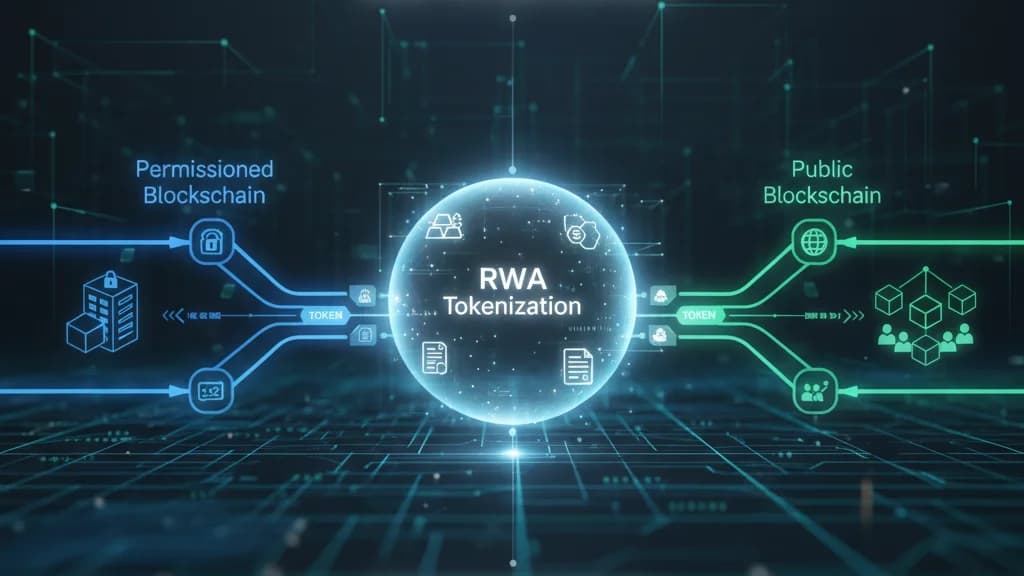
RWA tokenization is not converging on a single blockchain — it's fracturing into two. Banks and asset managers are quietly building parallel infrastructure: public chains like Ethereum for liquidity and market-facing activity, and permissioned networks like Canton for the institutional back-office processes they'd never expose on an open ledger. That's the thesis from Marcin Kaźmierczak, co-founder of blockchain oracle provider RedStone, who's watched this split develop from the inside.
Why No Single Chain Can Do It All
Here's the uncomfortable truth the industry doesn't love to say out loud: no blockchain has solved both liquidity and privacy well enough for institutional finance. Public chains offer composability and deep liquidity pools — Ethereum alone holds over $160 billion in stablecoins — but they're structurally open, which is a dealbreaker for bilateral settlement between counterparties who don't want their books on a public explorer.
Permissioned networks solve that. Digital Asset's Canton Network lets banks and asset managers tokenize and settle RWAs while keeping transaction details visible only to the parties involved — a setup far closer to how traditional financial infrastructure already works. The network processed $6 trillion in RWA value in 2025, and carries over $313 billion in represented tokens.
Kaźmierczak's framing is blunt: "There are some operations between institutions that simply have to stay private, and this is the value proposition that Canton offers very effectively." He added that the goal isn't to pick a winner — it's to operate on both rails simultaneously. "That's the reason we want to be on both of those legs."
There are some operations between institutions that simply have to stay private, and this is the value proposition that Canton offers very effectively.
What Does the Two-Rail RWA Model Mean for Ethereum?
Why institutions still land on Ethereum for market-facing RWA activity
Ethereum gets the market-facing half of institutional RWA activity — and that's not a small consolation prize. According to data from RWA tokenization tracker RWA.xyz, over $15 billion of the $26.4 billion in on-chain RWA tokens live on Ethereum. It's the deepest liquidity venue in smart contract history, and that depth matters when institutions want to plug tokenized assets into DeFi strategies like lending protocols or tokenized vault structures.
Kaźmierczak traces institutional confidence in Ethereum back to a specific moment: the 2022 Merge, when the network switched to proof-of-stake without collapsing. "In 2022, when I was talking to institutions, the Merge was like a big question mark for those institutions," he said. "They saw it worked without any hiccups, so it gave them this confidence."
That confidence translated slowly — institutional timelines run on annual budget cycles, not crypto sprint schedules. Kaźmierczak said most RWA projects at the institutional level kicked off in 2023 or 2024, which is why a wave of tokenization announcements hit in December of last year. The clock was already ticking — they just took their time.
The $30 Trillion Ceiling and the Regulatory Tailwind
Scale projections for tokenized assets are all over the map — which tells you something about how early this still is. McKinsey's June 2024 estimate put the market at roughly $2 trillion by 2030. Standard Chartered and Synpulse went considerably further, projecting a $30.1 trillion market by 2034. Whether either number lands anywhere close, the direction of travel is settled.
Regulatory movement in the US has removed one of the bigger institutional hesitation points. The GENIUS Act, passed in 2025, created a federal framework for stablecoins — the settlement layer that most tokenized asset infrastructure depends on. Without that clarity, institutions were building on sand. Now they have at least a foundation to work from.
Canton's founding roster tells you how seriously legacy finance has treated this. Digital Asset, Microsoft, Goldman Sachs, and Deloitte were all involved from the network's May 2023 launch. In September 2024, Digital Asset and the Depository Trust & Clearing Corporation ran a pilot of the US Treasury Collateral Network directly on Canton — not a proof-of-concept, a live pilot with real collateral.
Privacy Tech Debate: ZK Proofs vs. Permissioned Sharing
Canton's privacy model — permissioned data sharing, where only counterparties see a transaction — is not without critics. Matter Labs CEO Alex Gluchowski has argued publicly that zero-knowledge proof systems offer stronger security guarantees: even if administrators are compromised, attackers can't insert invalid transactions without generating a valid cryptographic proof of execution. That's a harder guarantee than "only the parties involved can see it."
Digital Asset's Yuval Rooz pushed back. In a blog post, Rooz argued that fully opaque ZK implementations could make financial market activity harder to audit, potentially hiding errors or fraud behind cryptographic walls — recreating, in his words, the kind of "black box" conditions that enabled corporate scandals like Enron. Neither side is wrong, exactly. The RedStone oracle infrastructure that feeds price data into RWA systems has to serve both models — and Kaźmierczak's dual-rail thesis essentially sidesteps the debate by treating both as necessary rather than competitive.
The honest answer is that the industry doesn't have a settled answer on institutional-grade privacy yet. The ZK-versus-permissioning debate is real, it's ongoing, and it matters. Banks experimenting with both approaches right now are effectively doing the industry's R&D for it.
Two Rails, One Verdict: Neither Chain Won
The dual-rail architecture isn't a story of blockchain winning institutional finance. It's a story of institutional finance bending blockchain to fit its existing complexity — and no single chain being able to handle all of it. Public chains get the liquid, composable, market-facing layer. Permissioned networks get the private, bilateral, counterparty-sensitive layer.
Call it pragmatism. Call it a compromise. Either way, the "one chain to rule them all" narrative is quietly being retired by the same institutions that were supposedly going to validate it.
The question isn't whether Ethereum or Canton wins. It's whether the bridges between them will ever work well enough to make the two-rail model feel seamless — or whether "parallel rails" just becomes a permanent architectural fixture of institutional finance, with all the friction and complexity that implies.


