
Bitflyer Tops Binance, Coinbase Volume on Nikkei Crash
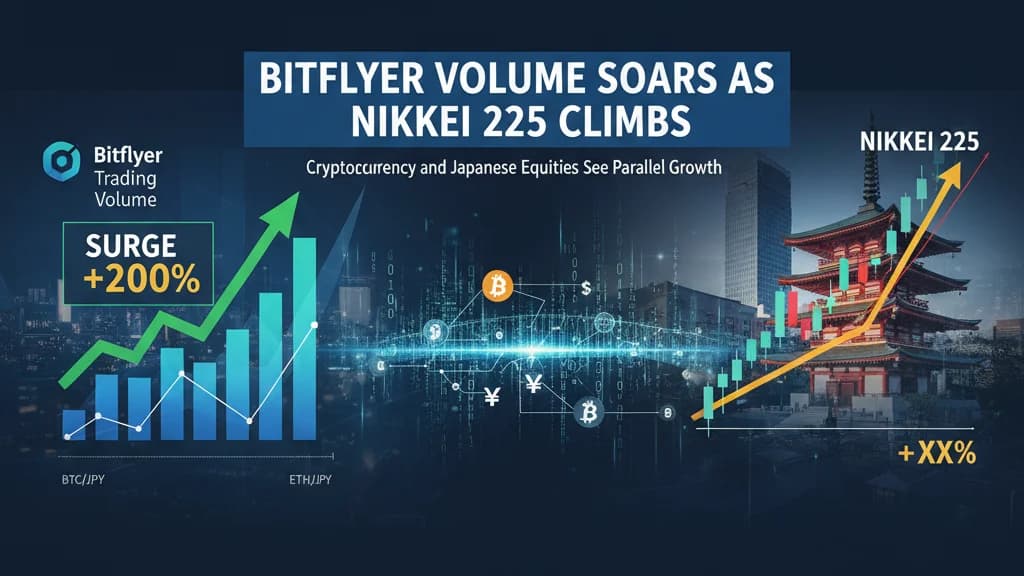
Bitflyer trading volume surged 200% on March 9 as Japan's Nikkei 225 fell 6.5% amid an oil price shock — outpacing Binance and Coinbase on the same day.
What to Know
- Bitflyer's 24-hour trading volume jumped 200% on March 9, outpacing Coinbase (112%) and Binance (75%) as Asia's equity markets sold off
- Japan's Nikkei 225 dropped roughly 6.5% while South Korea's Kospi tumbled ~8% and triggered a circuit breaker
- Bitcoin gained 2.05% against the Japanese yen during Asian hours — slightly stronger than the 1.86% move against the U.S. dollar
- South Korea sources roughly 70% of its crude from the Middle East, making it acutely exposed to the ongoing Iran war disruption
Bitflyer trading volume exploded 200% on Monday as Japan's Nikkei 225 cratered under the weight of a global oil shock — and the numbers put Binance and Coinbase to shame on the same day. According to CoinGecko data, the Tokyo-based exchange's 24-hour volume surge dwarfed the 112% jump on Coinbase and the comparatively modest 75% gain on Binance, painting a vivid picture of where traders ran when Asian equity markets started bleeding.
Why Did Bitflyer Trading Volume Spike 200% in One Day?
Japan's equity stress drove traders into crypto as a repositioning play
The short answer: panic repositioning, not conviction buying. Japan's Nikkei fell roughly 6.5% on the Monday open — one of its sharpest single-day drops in the post-pandemic era — and Japanese traders rotated hard into digital assets as traditional markets sold off. Bitflyer trading volume hitting 200% is less a story about crypto's appeal and more a story about what happens when you take away every other option.
Korean volumes told a softer story. Upbit rose 27.1% and Bithumb climbed 49.0% — both up, but nowhere near the frenzy on Bitflyer. That gap matters. South Korea's Kospi plunged roughly 8% and triggered a circuit breaker, yet Korean crypto traders barely flinched by comparison. The divergence hints at something structural: Japanese retail traders may simply have a higher reflex to move into crypto under equity stress.
All eyes now turn to Tuesday's open in Tokyo, where traders will be watching whether the surge in crypto volumes on Bitflyer and other Japanese exchanges holds or fades as equity markets attempt to stabilize.
The Oil Shock Behind Asia's Market Meltdown
The trigger was energy, not crypto. Oil prices surged past $100 a barrel as disruptions through the Strait of Hormuz — tied directly to the ongoing Iran war — sent shockwaves through every energy-dependent economy in Asia. Japan, South Korea, and Taiwan don't have the luxury of domestic oil reserves. They import almost everything, and a big chunk of that flows through exactly the body of water currently under military stress.
South Korea bears the sharpest exposure. The country burns through roughly 2.5 million barrels of crude per day and imports nearly all of it — about 70% sourced from the Middle East, according to the International Energy Agency, which has called South Korea an 'energy island' with no interconnections and one of the most energy-intensive economies in the OECD. That's why the Nikkei 225 narrative gets complicated: Japan was bad, but Korea was arguably worse on the macro fundamentals.
Taiwan faces similar constraints. The island relies on imported energy for roughly 97% of its supply, though it has meaningfully diversified away from the Middle East over the past decade — Middle Eastern crude now accounts for just 35% of Taiwan's imports, down from over 70% not long ago, with the United States emerging as a major alternative supplier. Taiwan's Taiex still dropped about 4.9% on Monday, but that diversification may explain why it fell less than its neighbors.
What Does Bitcoin's Yen Performance Actually Tell Us?
Here's the number that deserves more attention than it's getting. Bitcoin price rose roughly 2.05% against the Japanese yen during Asian trading hours, compared with 1.86% against the U.S. dollar and about 1.64% against the Korean won, according to TradingView data. The yen outperformance has two components — currency weakness as the yen slipped against the dollar, and genuine local demand on Japanese exchanges.
Call it what it is: crypto as a pressure valve, not a safe haven. Traders weren't buying BTC because they believe in a decoupled digital economy. They were buying it because the Nikkei was on fire and they needed somewhere to go. That's not a bad reason to buy — but it's worth being honest about the distinction.
Does Japan's Market Resilience Change the Crypto Story?
Japan's Nikkei 225 fell hard, but the index's composition arguably cushioned the blow relative to Korea and Taiwan. The Nikkei includes a broader mix of industrial, financial, and consumer names — unlike the more concentrated tech-heavy indices in Seoul and Taipei, where a single sector shock hits harder. That relative resilience is one reason crypto volumes on Bitflyer ran so hot: Japanese equity traders had more room to rotate into alternatives without their primary portfolio completely collapsing.
Whether Monday's volume spike holds into Tuesday is the real question. Panic-driven volume tends to fade when equity markets stabilize. If the Nikkei finds a floor, Bitflyer's numbers likely pull back toward normal — and Binance and Coinbase reclaim their usual dominance. But if the oil disruption deepens and Asian equities keep bleeding, Japan could stay at the top of the volume charts for longer than anyone expected.