
Public Bitcoin Miners Dumping BTC for AI, a Historic Mistake
Public Bitcoin miners are pivoting to AI data centers in 2026, selling 15,000+ BTC. Is this a rational hedge or the same trap that wrecked railroad barons?
What to Know
- Over 15,000 bitcoins have been sold off by major public miners to fund AI data center transitions
- Cipher Digital rebranded from Cipher Mining and secured 600 MW of contracted HPC capacity, including deals with AWS and Google-backed Fluidstack
- The average industry cost to mine one bitcoin sits at ~$87,000 — above spot price — which is the stated reason most U.S. miners are pivoting, according to Sazmining CEO Kent Halliburton
- Goldman Sachs flagged AI valuations as getting "frothy" in an October 2025 report titled 'AI: In a bubble?'
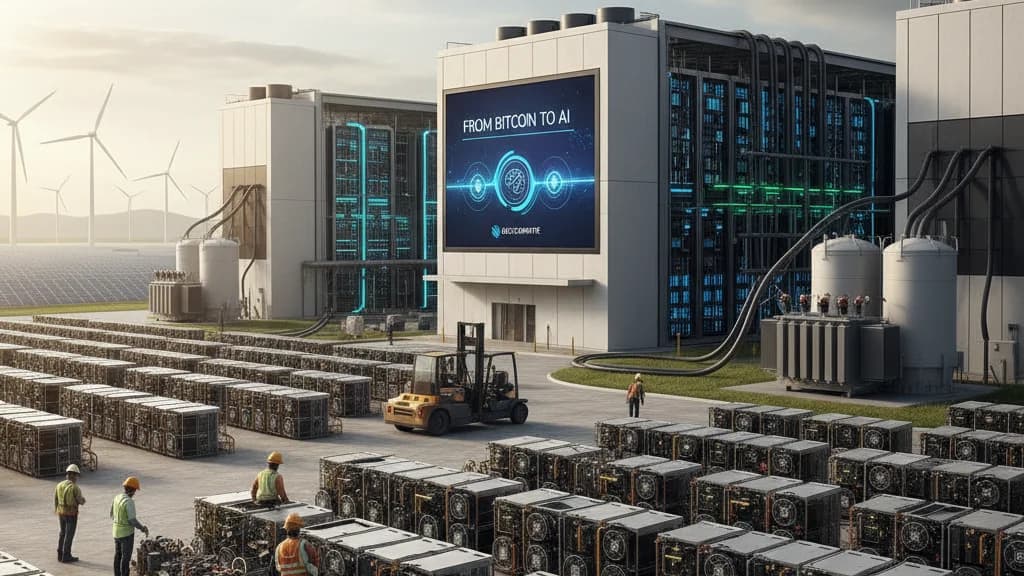
Public Bitcoin miners across the United States are selling off their bitcoin holdings and converting data center capacity to AI workloads — and the scale of this exit is genuinely staggering. More than 15,000 BTC has left miner balance sheets to fund the transition, several household names in the mining space have signed decade-long leases with hyperscalers like Microsoft, Google-backed Fluidstack, and AWS, and at least two major players have gone so far as to rebrand entirely, scrubbing the word 'Bitcoin' from their corporate identity. The question isn't whether this is happening. It's whether they're walking into the same wall that buried railroad tycoons in 1873 and fiber-line builders in 2001.
The Miners Who Stopped Being Miners
Let's start with what's actually happening on the ground, because the deal flow here is extraordinary. IREN Limited kicked things off in April 2025, inking a $9.7 billion, five-year agreement with Microsoft to deploy 200 MW of critical IT load running NVIDIA GB300 GPUs at its Texas campus — the kind of contract that makes a board of directors forget it ever cared about block rewards. That's not a pivot. That's a metamorphosis.
TeraWulf went the Google route, executing multiple HPC expansions through Fluidstack with Google backing, locking in 10-year agreements for over 200 MW. Hut 8 signed a 15-year, 245 MW deal with the same Fluidstack-Google arrangement, with options that could eventually stretch to over 1,000 MW. Core Scientific extended its HPC footprint to 270 MW through CoreWeave, which serves Microsoft and OpenAI workloads. Riot Platforms partnered with AMD on a 10-year, 25 MW operational lease and is running assessments for a further 600 MW at its Corsicana site — though no hyperscaler has signed on there yet.
MARA Holdings took a different approach, setting up a joint venture with Starwood Capital's Starwood Digital Ventures to target 1 GW of near-term IT capacity, expandable past 2.5 GW for hyperscale and AI workloads. Starwood handles the financing and tenant sourcing. No named hyperscalers have committed yet, but the structural direction is obvious.
Then there are the two that went all the way. Bitfarms didn't just add an AI division — CEO Ben Gagnon told reporters, flat out, "We are no longer a Bitcoin company." The rebranded entity, Keel Infrastructure, kept the word 'Bit' in the corporate family name, which reads a bit like someone leaving a relationship but holding onto one of their ex's records. The gesture means nothing to the balance sheet.
Cipher Mining's transformation was equally complete. Now operating as Cipher Digital after a full rebrand, the company divested its 49% stake in the Alborz, Bear, and Chief mining sites — three of its largest Bitcoin-producing assets — and announced 600 MW of contracted HPC capacity. That includes a 15-year, 300 MW lease with AWS and a 10-year, 300 MW lease with Fluidstack backed by Google. At roughly $6 billion in estimated market cap, Cipher Digital is now one of the biggest HPC landlords in the country that most people still think of as a Bitcoin miner.
They had the power contracts, the land, the infrastructure — everything you need to mine bitcoin cheaply — and they're handing it to Microsoft and Google in exchange for lease checks.
Why Are Public Bitcoin Miners Pivoting to AI?
What is driving Bitcoin miners to abandon BTC for AI data centers?
The short answer is pain. The average cost to produce a single bitcoin sits at approximately $87,000 across the U.S. mining industry — above where spot price has been trading — according to Kent Halliburton, Co-Founder and CEO of Sazmining, who shared the figure in an exclusive interview. Sazmining is a private miner that operates on frontier renewable energy in places like Paraguay and Ethiopia, well outside the American grid-power belt. When the thing you make costs more to manufacture than its market price, you start looking for an exit.
Halliburton was careful to note that the $87,000 figure isn't a flat reality across the whole industry. "That's an industry average — it includes guys running old-gen rigs on grid power in Texas," he said. At Sazmining's own sites, the production cost on a pure energy basis runs between $50,000 and $64,000 per coin, using 100% renewable energy — a genuine 10 to 30 percent discount to spot. The profitability is there, he argued. It just requires operating on cheaper energy or accepting a longer investment horizon.
Neither of those options is particularly accessible for American public miners. Longer investment horizons don't play well with quarterly earnings calls, and building out genuinely cheap energy infrastructure — or moving operations offshore — takes years and carries political risk. So the cost structure that American miners built on U.S. grid power looks increasingly like a trap they set for themselves, and AI infrastructure offers a way out: dollar-denominated, long-term contract revenue from the most creditworthy counterparties in the world.
Halliburton didn't pull punches when asked to characterize what the public miners gave up to get here. These companies, he said, "went from securing the Bitcoin network to securing rack space for hyperscalers" — and they funded the transition by selling over 15,000 bitcoins off their balance sheets. Call it survival. Call it strategy. Call it whatever you want, but don't call it a win for Bitcoin.
CleanSpark Is Still Playing Both Sides
Not every major public miner has gone all-in on the hyperscaler model. CleanSpark is pursuing a land-bank strategy — acquiring Texas land and power capacity for potential AI and HPC conversion, including 447 acres in Brazoria County with capacity for 300 to 600 MW and an Austin County site contributing to 890 MW in aggregate. Tenant discussions are ongoing, but no hyperscaler leases have been disclosed.
That measured approach might look like hesitation, or it might look like optionality. The land and power assets are real regardless of which way the AI demand curve bends. If the hyperscale AI buildout keeps growing, CleanSpark has infrastructure to monetize. If the market shifts toward self-hosted or distributed compute models — as some prominent venture capitalists are beginning to argue — those same sites can go back to mining bitcoin.
Riot Platforms is nominally still hedging too, though its 25 MW AMD deal is operational and the 600 MW assessment at Corsicana is clearly directional. Riot hasn't publicly broken with Bitcoin the way Bitfarms has, but infrastructure roadmaps tell a different story than press statements usually do.
Have We Seen This Movie Before?
Does the AI infrastructure boom mirror historical bubble cycles?
The history of infrastructure booms is not comforting for people who build the tracks. In the late 1800s, railroad construction was the defining technological bet of its era — capital poured in from all directions, companies took on enormous debt to lay track, and when demand growth couldn't keep pace with the borrowed capital, the whole thing collapsed. The Panic of 1873 was, in meaningful part, a railroad debt crisis. Most of the companies that built the railroads either went bankrupt or were absorbed in the subsequent consolidation. J.P. Morgan — not the railroad builders — ended up owning the upside, after buying the wreckage for a fraction of what it cost to build.
The dot-com era ran the same script. Fiber-line infrastructure companies spent the late 1990s and early 2000s stringing cable across ocean floors and continents, chasing traffic projections that never materialized at the speed required to service the debt. When the crash came, the graveyard of those companies was enormous. Google and Meta came along years later and bought that infrastructure at deep discounts — pennies on the original construction dollar — and built the businesses everyone now recognizes. The builders lost. The consolidators won. Every time.
Goldman Sachs published a report in October 2025 titled "AI: In a bubble?" — acknowledging that big tech's AI capex could be justified by existing revenues, but warning that valuations across the AI infrastructure space were starting to look "frothy." David Chan at Sequoia has been tracking a structural gap between AI-driven revenue and capital expenditure since 2023 — a gap now estimated at $600 billion. Hyperscaler capex commitments for 2026 top $700 billion, according to publicly available guidance. Against that number, OpenAI's $20 billion in annual recurring revenue — genuinely impressive for a company of its age — represents just roughly 3% of projected 2026 hyperscaler capex, according to Futurum Group. Add Anthropic's $9 billion run rate, plus the entire field of pure-play AI vendors — Cohere at $150 million ARR, Mistral at roughly $400 million, Perplexity at $148 million annualized — and you're looking at less than $35 billion in combined 2026 revenue against infrastructure spending an order of magnitude larger.
Chamath Palihapitiya — who backed Groq, watched it get licensed by NVIDIA in a $20 billion deal, and spent years inside Facebook as it scaled into a hyperscaler — has gone on record with his doubts about where the infrastructure profits actually land. If someone with that resume is skeptical, it deserves more than a passing read.
The Self-Hosted AI Wildcard Nobody Is Pricing In
Here's the argument nobody running a public mining company's AI pivot deck seems to be seriously stress-testing: what if cloud AI demand gets disrupted from below, before the hyperscalers even recover their capex?
Palihapitiya has argued that corporations will eventually confront the reality of what cloud AI actually means — handing their most sensitive internal data to third parties whose incentives around data usage are opaque and whose legal obligations to protect that data are murky at best. The U.S. Southern District of New York recently ruled that users don't have attorney-client privilege when getting legal assistance from AI chatbots, meaning sensitive AI-assisted legal discussions could be subpoenaed and used in court proceedings. That's not a footnote. That's a demonstration of exactly how the legal framework hasn't caught up to the data-exposure risks of cloud AI for enterprise users.
The OpenClaw phenomenon makes this appetite for self-hosted intelligence concrete. A self-hosted AI agent hit 289,000 GitHub stars in weeks — surpassing Linux and React, two of the most widely-deployed pieces of software infrastructure on the planet. The project didn't win on benchmarks. It won because it felt owned. It runs on your hardware, accumulates memory about your preferences, updates itself, and doesn't funnel your context through a company's servers. People started buying Mac minis specifically to run it, pairing the hardware with API plans costing roughly $200 a month.
Apple's positioning in this dynamic deserves a note — not because Apple has had good AI products (it hasn't), but because its hardware architecture happens to be well-suited for local model inference. Recent Mac machines use unified memory rather than separate RAM and VRAM, letting users run models locally that would otherwise require dedicated GPU hardware. Chinese open-source AI models, made leaner by necessity due to Nvidia chip sanctions, are also narrowing the performance gap with closed Western models. If self-hosted AI becomes the preferred approach for enterprise and privacy-sensitive use cases — driven by genuine data sovereignty concerns and the commoditization of compute — the demand picture for hyperscale GPU racks gets materially less certain. And the miners who liquidated their bitcoin reserves to build those racks will have bet on the wrong side of that shift.
What Does This Mean for Bitcoin Holders?
If you're holding BTC, this story matters more than it probably looks on the surface. Public miners were, by the structural logic of their business model, natural accumulators of bitcoin — they produced it constantly and held significant reserves on their balance sheets. That accumulation flywheel is now running in reverse: companies selling bitcoin reserves to fund capex for infrastructure that may or may not generate returns within a decade.
The deeper irony is that Halliburton's core argument is hard to refute. The American public miners had everything they needed to become dominant low-cost producers as the post-halving industry consolidated: locked-in power contracts, land, existing infrastructure. That combination is genuinely hard to replicate. Instead, they handed those structural advantages to Microsoft and Google in exchange for lease income — a trade that makes Q1 sense and possibly catastrophic decade-level sense.
Private miners operating outside the U.S. on cheap renewable energy — the Sazmining model — are now arguably positioned exactly where the public miners could have been. Mine bitcoin on a real margin, hold through the low-price cycle, accumulate before the market turns. History says the patient, low-cost producers eventually capture the territory the over-leveraged builders abandoned.
The public miners say they're riding the AI gold rush. History says the gold rush is usually the one doing the riding.