
SEC, CFTC Sign Pact to Coordinate Crypto Rules
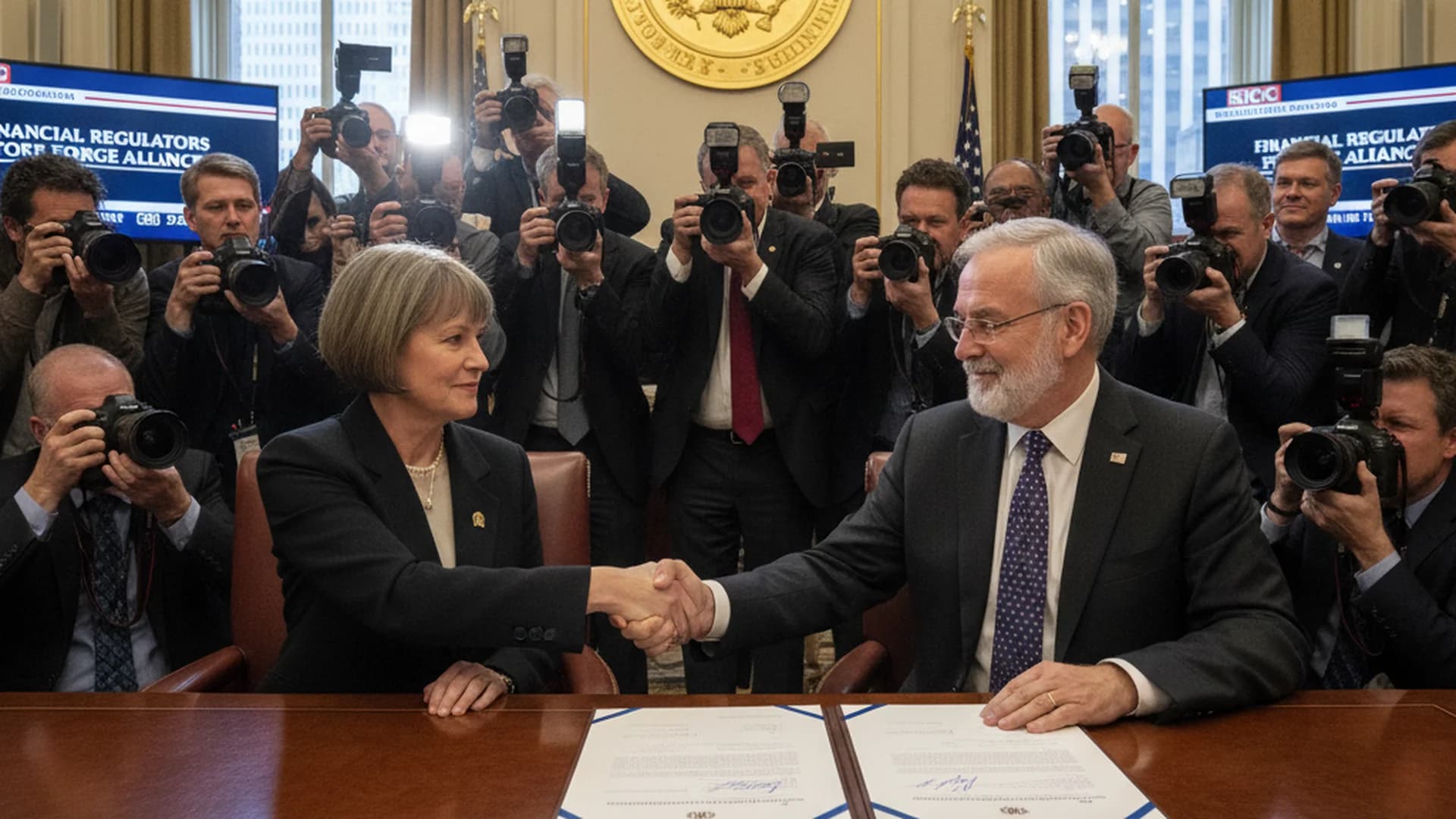
The SEC and CFTC signed a memorandum of understanding on crypto rules in 2026, launching a Joint Harmonization Initiative to end decades of turf wars.
What to Know
- The SEC and CFTC signed a memorandum of understanding to align crypto rules and slash duplicated oversight
- A Joint Harmonization Initiative was launched covering product definitions, clearing rules, and reporting requirements
- The CFTC Innovation Advisory Committee now includes executives from Coinbase, Ripple, Kraken, Robinhood, and Nasdaq
- Industry insiders say the pact could draw institutional capital off the sidelines by reducing jurisdictional ambiguity
The SEC CFTC memorandum of understanding signed this week is the most concrete regulatory truce crypto has seen in years — and for an industry that's spent the better part of a decade dodging conflicting agency demands, it lands like a breath of air. The Securities and Exchange Commission and the Commodity Futures Trading Commission formalized a coordination agreement that spells out exactly how the two regulators will share the road on rulemaking, enforcement, and supervision wherever their authority bleeds into each other.
Decades of Turf Wars, One Document
SEC Chairman Paul Atkins didn't mince words. "For decades, regulatory turf wars, duplicative agency registrations, and different sets of regulations between the SEC and CFTC have stifled innovation and pushed market participants to other jurisdictions," he said in a statement. That's not a small admission — it's a sitting chairman of the most powerful securities regulator on earth acknowledging the system was broken.
The memorandum of understanding formalizes how the agencies plan to coordinate across overlapping jurisdictions, including product classifications, clearing and margin frameworks, reporting for intermediaries and funds, and oversight of trading venues. Think of it as a shared rulebook — not final legislation, but the scaffolding that makes future legislation manageable.
What Does the Joint Harmonization Initiative Actually Cover?
What does the Joint Harmonization Initiative cover?
The Joint Harmonization Initiative is the operational engine behind the pact. CFTC Chairman Brian Quintenz — now replaced by Michael Selig, who said the goal was to "harmonize regulatory frameworks to provide comprehensive and seamless financial market oversight" — outlined workstreams that go beyond PR language. Clarifying which assets fall under which agency, modernizing clearing rules, and cutting the parallel approval processes firms currently endure are all on the table.
Part of the stated work includes building a "fit-for-purpose regulatory framework" for crypto assets and emerging technology. That phrase has appeared in regulatory documents before and gone nowhere. The difference here is it's attached to a formal inter-agency coordination mechanism rather than a press release with no follow-through. Joint interpretations and coordinated policymaking are also flagged — which could set the groundwork for substituted compliance, where satisfying one agency's requirements automatically satisfies both.
Steven Wu, chief operating officer at tokenization engine Clearpool, called the agreement a signal of "the next phase of the industry." Until now, uncertainty around "how different tokens are classified and which regulator has jurisdiction" had become a genuine barrier to product development. "When that question is unclear, it becomes difficult for firms to design new financial products with confidence," Wu said. Greater alignment, he added, could "remove some of the ambiguity that has kept institutional capital on the sidelines."
If the SEC and CFTC become more closely aligned, the impact could go beyond better communication.
The CFTC's Industry Army
Separately — but not unrelatedly — the CFTC named dozens of senior crypto executives to its Innovation Advisory Committee on Thursday. The roster reads like a who's-who of digital assets: Coinbase, Uniswap Labs, Ripple, Kraken, Robinhood, CME Group, and Nasdaq all made the list. That's an unusually dense concentration of industry players inside an advisory body for a regulator that, just two years ago, was fighting turf battles rather than holding strategy sessions with the firms it oversees.
The move cements the CFTC's positioning as the friendlier of the two agencies toward crypto — a dynamic that predates the Trump administration but has accelerated sharply under it. With Congress still grinding through unresolved questions on crypto market structure legislation, the CFTC is building its advisory infrastructure now, presumably to have industry input ready whenever a legislative framework finally lands.
Does This Change Anything for Builders?
Probably yes — though the degree depends on whether this stays a framework or becomes enforcement reality. Samar Sen, head of international markets at institutional digital asset firm Talos, pointed out that institutional players "rarely sit neatly within a single category." Firms operating across spot, derivatives, and tokenized markets simultaneously have been forced to navigate "divergent supervisory expectations and reporting workflows for the same underlying activity." That's expensive, slow, and a deterrent to launching new products.
Sen's read: better coordination strips away "double-handling" of approvals and gives firms "the clarity they need to scale products without the burden of navigating competing jurisdictional requirements." Wu framed the announcement as a retention play — "firms evaluating whether to build in the U.S. or offshore now have a reason to stay," with workable compliance becoming a competitive advantage rather than a cost center.
Call it cautious optimism. The pact doesn't resolve the fundamental legislative gap — only Congress can do that — but it does mean the two agencies are no longer actively undercutting each other while they wait. For builders, that's not nothing.
What Does This Mean for Investors?
Reduced regulatory friction at the agency level is a direct positive for any project that's been stuck in jurisdictional limbo — which is a lot of them. Clearer product classification means tokens that were previously untouchable for institutional funds become eligible. Streamlined approvals means faster time-to-market for compliant products. And a "fit-for-purpose" crypto framework, if it materializes, hands a competitive moat to the U.S. market relative to offshore alternatives. The caveat: memoranda of understanding are administrative instruments, not law. Congress still owns the final call.
Frequently Asked Questions
What is the SEC CFTC memorandum of understanding?
The SEC CFTC memorandum of understanding is a formal coordination agreement signed in 2026 that outlines how both agencies will align on rulemaking, enforcement, and supervision where their authority overlaps — particularly for crypto assets, derivatives, and tokenized products.
What does the Joint Harmonization Initiative cover?
The Joint Harmonization Initiative covers product definitions, clearing and margin rules, reporting requirements for intermediaries and funds, trading venue oversight, and building a fit-for-purpose regulatory framework for crypto assets and other emerging technologies.
Who is on the CFTC Innovation Advisory Committee?
The CFTC Innovation Advisory Committee includes senior executives from Coinbase, Uniswap Labs, Ripple, Kraken, Robinhood, CME Group, and Nasdaq, among dozens of others — one of the broadest concentrations of crypto industry representation inside a CFTC advisory body.
Why does the SEC CFTC pact matter for crypto firms?
For crypto firms, the pact reduces duplicated approvals, clarifies which regulator governs which products, and signals a path toward substituted compliance — where satisfying one agency's rules satisfies both — lowering costs and removing friction from bringing compliant products to market.


